
Introduction
Crypto markets move quickly. A coin can reach an important level while you are busy, distracted, or watching too many charts at once. For beginners, this often leads to emotional decisions: entering too late, selling too early, or reacting to price movement without a clear plan.
This is where crypto price alerts can help.
A crypto price alert is a reminder that a specific price level has been reached. It is not a trading signal, a prediction, or financial advice. It is simply a tool that helps users wait for planned levels instead of reacting to every market move.
For paper traders, price alerts are especially useful because they support better practice habits. Users can define a level, wait for the alert, make a simulated decision, and then review the result inside a virtual portfolio.
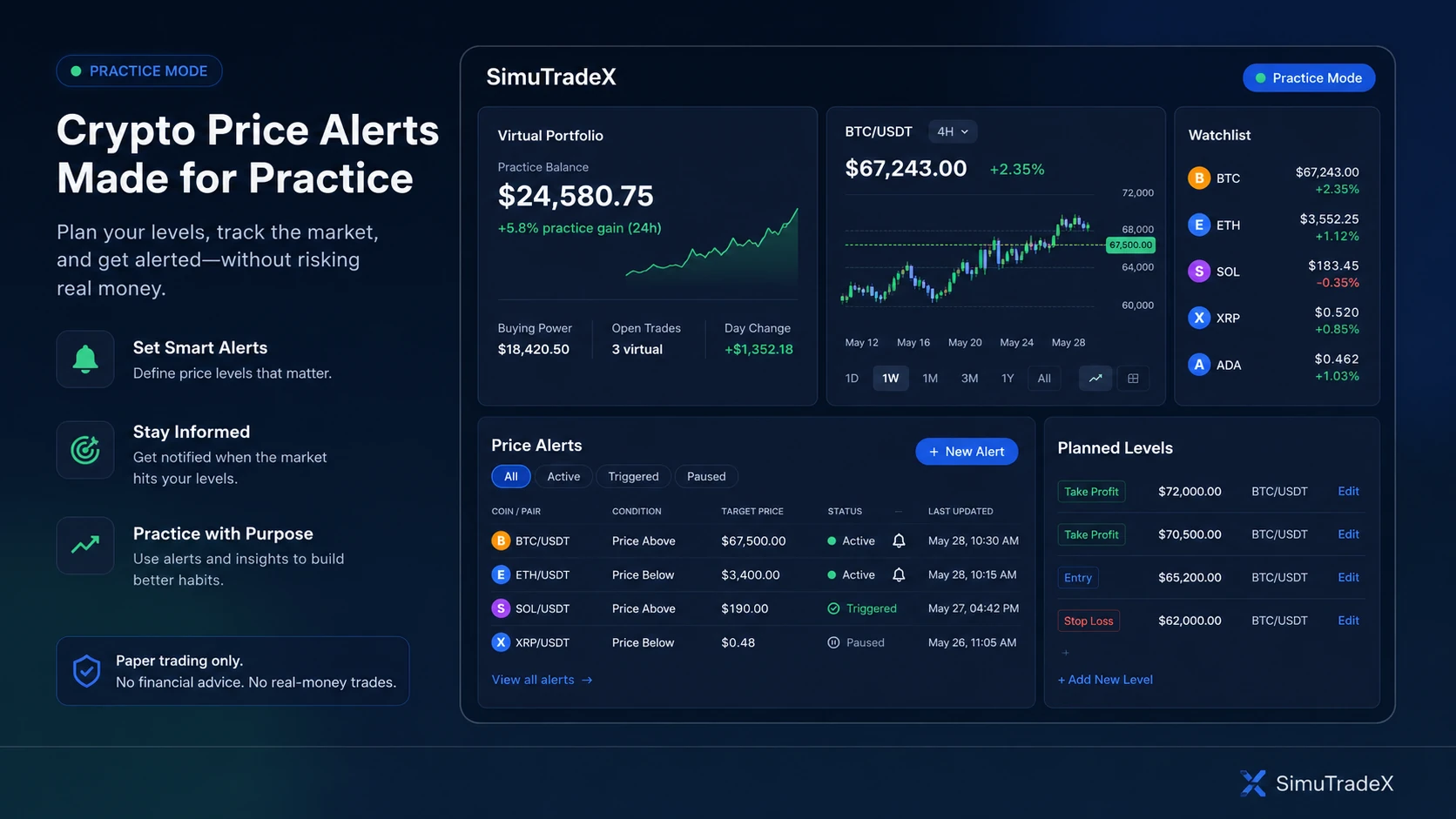
SimuTradeX is built around this type of structured practice. Users can combine crypto price alerts with virtual portfolio tracking, simulated automation rules, and an AI-ready portfolio snapshot to review decisions more clearly.
Important: SimuTradeX is for paper trading only. It does not provide financial advice, trading signals, price predictions, or real-money trade execution.
What Are Crypto Price Alerts?
Crypto price alerts are notifications or reminders based on price levels. A user chooses a coin, defines a price, and waits for the alert to trigger when that level is reached.
For example, a beginner may decide to watch Bitcoin near a specific support level or Ethereum near a breakout level. Instead of staring at the chart all day, the user can set an alert and return to the plan only when the market reaches that level.
In simple terms, crypto price alerts help users:
- Plan important price levels in advance
- Reduce constant chart watching
- Practice patience
- Avoid random entries
- Review decisions with clearer context
- Build a more repeatable trading routine
For beginners, this can make crypto paper trading calmer and more structured.
Why Price Alerts Matter in Paper Trading
Paper trading is most useful when it is treated like a real practice routine. Random simulated trades usually do not teach much. Planned simulated trades are different because they help users understand why a decision was made.
Price alerts create a bridge between planning and action.
Before opening a paper trade, a user can ask:
- Which coin am I watching?
- Which price level matters?
- Why does this level matter?
- What will I do if the alert triggers?
- How much of my virtual portfolio should I use?
- How will I review the decision later?
This turns a simple alert into a practice checkpoint. The alert does not tell the user what to do. It reminds the user to return to the plan.
That difference is important. A price alert is a planning tool, not a signal service.
Price Alerts vs Trading Signals
Beginners sometimes confuse price alerts with trading signals. They are not the same.
A trading signal usually tells someone to buy, sell, or take a specific action. A price alert only says that a selected price level has been reached.
| Area | Price Alert | Trading Signal |
|---|---|---|
| Main Function | Reminds the user that a planned level was reached | Suggests or recommends a trading action |
| Decision Making | User decides what to do next | Signal provider may suggest the decision |
| Best Use | Planning, patience, and review | External trade recommendation |
| Risk | Depends on how the user reacts | Can encourage blind following |
| SimuTradeX Role | Practice and review support | Not provided |
SimuTradeX focuses on price alerts as a paper trading practice tool. The goal is to help users plan, simulate, and review — not to provide predictions or trading instructions.
How to Use Crypto Price Alerts in a Practice Routine
A good alert routine is simple. The user should not set alerts randomly on every coin. Each alert should have a reason.
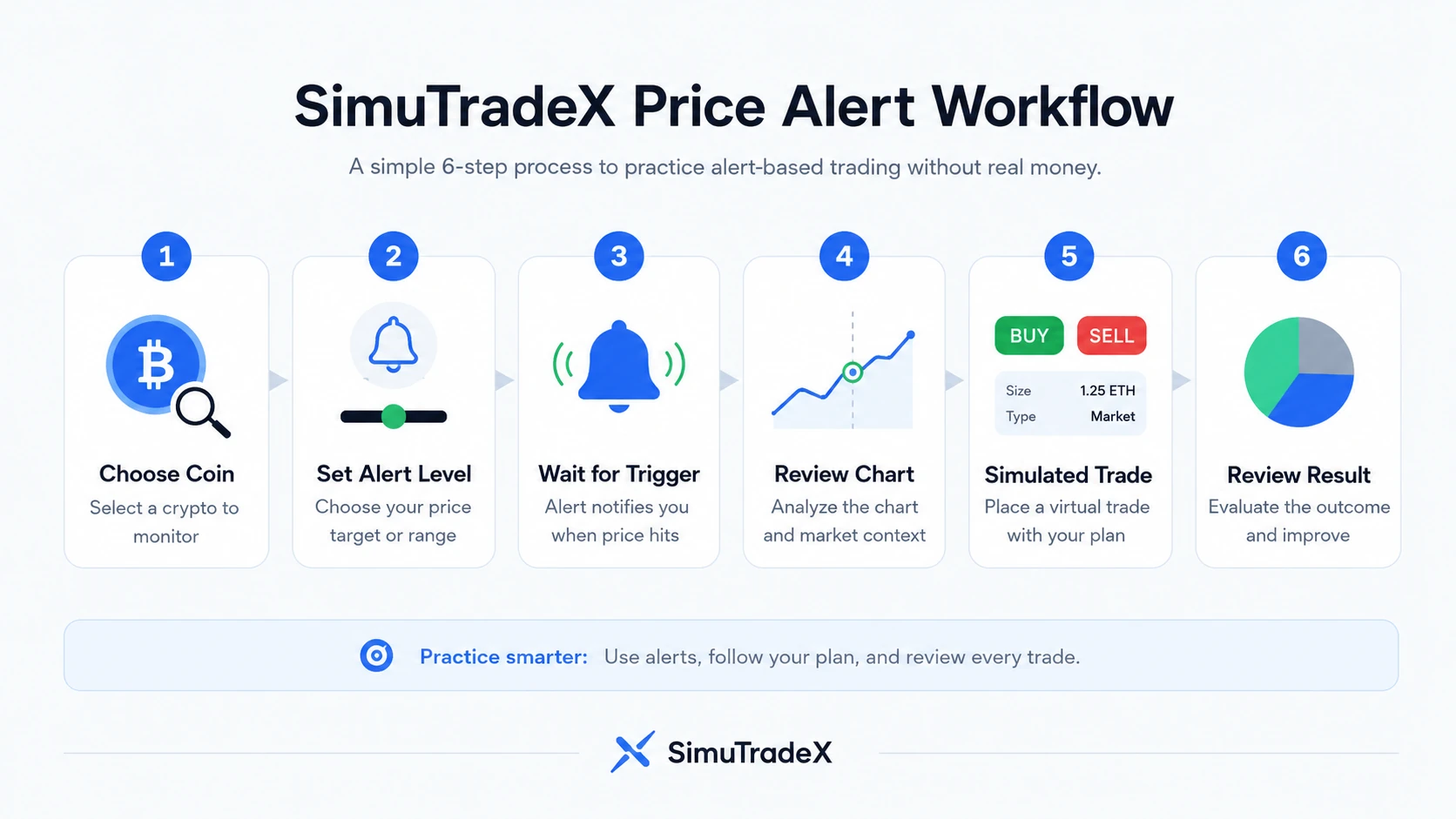
A basic paper trading alert workflow can look like this:
- Choose one coin to watch.
- Identify a price level that matters to your practice idea.
- Set a crypto price alert for that level.
- Write down why the level matters.
- Wait for the alert instead of reacting early.
- When the alert triggers, review the chart and your plan.
- Place a simulated buy or sell decision only if it matches your plan.
- Track the result inside your virtual portfolio.
- Review the trade after it closes.
This process helps users practice discipline. Instead of chasing movement, they wait for conditions they already defined.
Common Types of Crypto Price Alerts
Different users may set alerts for different reasons. In paper trading, the purpose is not to predict the future. The purpose is to practice how decisions are made around important levels.
Breakout Alerts
A breakout alert is set near a level where the user wants to observe whether price moves beyond a previous range or resistance area.
For paper trading, this can help beginners practice patience. Instead of buying too early because the price is moving, they can wait until the planned level is reached and then review the situation.
Pullback Alerts
A pullback alert is used when a user wants to observe a coin after price moves back toward a specific area.
This can help users practice entries after movement slows down instead of chasing a fast candle. The alert gives the user a reason to return to the chart with more context.
Support and Resistance Alerts
Support and resistance alerts are useful for practicing how price behaves around previous reaction zones.
In a simulator, users can set alerts near these areas and then review whether their simulated decisions were planned or emotional.
Portfolio Protection Alerts
Even in paper trading, alerts can be useful for portfolio awareness. If a coin in a virtual portfolio moves sharply, an alert can remind the user to review exposure, unrealized PnL, and position size.
This is helpful because a single position may affect the entire virtual account.
How Price Alerts Improve Trading Discipline
Discipline is one of the hardest parts of trading practice. Beginners often act before their plan is ready. They may enter because a coin is trending, exit because of fear, or change their idea too quickly.
Price alerts can support discipline in several ways:
- They encourage users to define levels before acting.
- They reduce the need to watch every small price movement.
- They create a pause between market movement and user reaction.
- They make trade review easier because the original level is clear.
- They help users compare planned decisions with impulsive decisions.
Over time, this can make paper trading more useful. The user is not just clicking buy or sell. The user is building a process.
Using Price Alerts With a Virtual Portfolio
Price alerts become more powerful when they are connected to portfolio review.
A single alert may seem small, but it can affect the entire virtual portfolio. For example, if a user already has several simulated positions in similar coins, another alert on the same market theme may increase concentration risk.
Before acting on an alert, users can review:
- Current virtual cash
- Open simulated positions
- Unrealized PnL
- Portfolio allocation
- Exposure to one coin or one market theme
- Recent trade history
This makes the decision more realistic. The question is not only “Did the alert trigger?” The better question is “Does this simulated trade still make sense inside my virtual portfolio?”
That is why SimuTradeX connects price alerts with virtual portfolio tracking and review tools.
Common Mistakes When Using Crypto Price Alerts
Price alerts are simple, but they can still be used poorly. Here are common mistakes beginners should avoid during paper trading practice.
Setting Too Many Alerts
Too many alerts can create noise. If every small move triggers a reminder, the user may feel even more distracted.
A better approach is to set fewer alerts with clearer reasons.
Using Alerts Without a Plan
An alert should connect to a practice idea. If the user does not know why the level matters, the alert may not help.
Before setting an alert, write down the reason for the level.
Reacting Immediately After Every Alert
An alert does not mean the user must enter a trade. It only means the level has been reached.
After an alert triggers, users should review the chart, portfolio context, and original plan before making a simulated decision.
Ignoring Position Size
Even in paper trading, position size matters. If every alert leads to a large simulated position, the virtual portfolio may become unrealistic.
Users should practice position sizing as part of every alert-based trade.
Not Reviewing Alert-Based Trades
The alert itself is only one part of the process. The real learning happens during review.
After the trade, users should ask whether the alert improved the decision or simply created another emotional reaction.
A Simple Crypto Alert Checklist
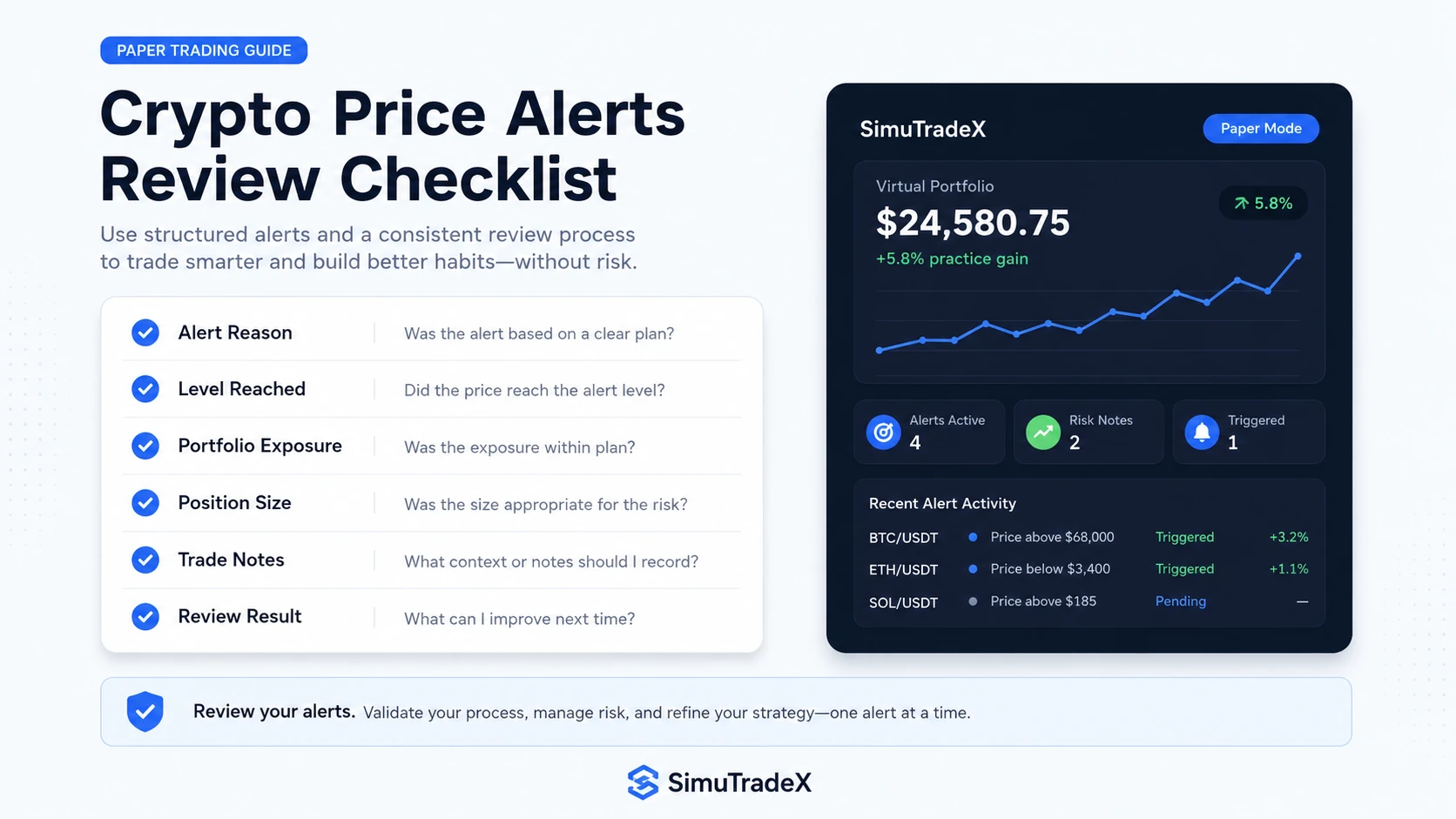
Before acting on a crypto price alert inside a paper trading simulator, users can follow this checklist:
- Did I set this alert before the market reached the level?
- Do I know why this level matters?
- Does the current chart still match my original idea?
- How much virtual capital would this simulated trade use?
- What is my portfolio exposure right now?
- What would make me exit the simulated trade?
- How will I review the result later?
This checklist helps users slow down and practice better decision-making.
How SimuTradeX Supports Crypto Price Alerts
SimuTradeX is designed for simulated trading practice, not real-money execution. Price alerts are part of a wider paper trading workflow.
Users can use SimuTradeX to:
- Set crypto price alerts around planned levels
- Practice simulated buy and sell decisions
- Track results inside a virtual portfolio
- Review trade history after alerts trigger
- Test simulated automation rules
- Export AI-ready portfolio snapshots for deeper review
This helps users move from random reaction to structured practice.
Instead of asking only “Should I buy now?”, users can ask better questions:
- Why did I set this alert?
- Did I wait for the planned level?
- Did I follow my paper trading plan?
- Was my virtual position size reasonable?
- What did this alert-based trade teach me?
Final Thoughts
Crypto price alerts are simple, but they can make paper trading much more useful.
They help users define levels, wait with patience, avoid constant chart watching, and review decisions with clearer context.
The key is to use alerts as planning tools — not as trading signals.
With SimuTradeX, users can combine crypto price alerts, virtual portfolio tracking, simulated automation rules, and AI-ready snapshots to build a more structured paper trading routine.
Paper trading only. No financial advice. No real-money trades are executed.
FAQ
What is a crypto price alert?
A crypto price alert is a reminder that a selected coin has reached a specific price level. It helps users return to a planned level instead of watching charts constantly.
Are crypto price alerts trading signals?
No. A price alert is not a trading signal. It does not tell users to buy or sell. It only reminds them that a planned price level has been reached.
How do price alerts help paper trading?
Price alerts help paper traders practice patience, plan levels in advance, reduce emotional reactions, and review simulated trades with clearer context.
Can beginners use crypto price alerts?
Yes. Beginners can use price alerts to build a simple trading routine, practice waiting for planned levels, and review decisions inside a virtual portfolio.
Does SimuTradeX provide real trading alerts?
SimuTradeX provides alerts for paper trading practice and review. It does not provide financial advice, trading signals, price predictions, or real-money trade execution.
Should every price alert become a trade?
No. An alert only means that a price level was reached. Users should review their plan, portfolio context, and risk before making any simulated decision.