
Crypto Paper Trading Journal: A Practical Review Guide
A crypto paper trading journal turns isolated simulated trades into a structured learning process. Instead of remembering only whether a virtual position gained or lost value, you record what you expected, why you acted, what happened, and what you would change next time.
This matters because a result alone does not tell you whether a decision was sound. A carefully planned paper trade can have an unfavorable outcome, while an impulsive decision can occasionally appear successful. A useful journal helps you separate decision quality from short-term results.
Important: SimuTradeX is for paper trading only. It does not provide financial advice, trading signals, price predictions, or real-money trade execution.
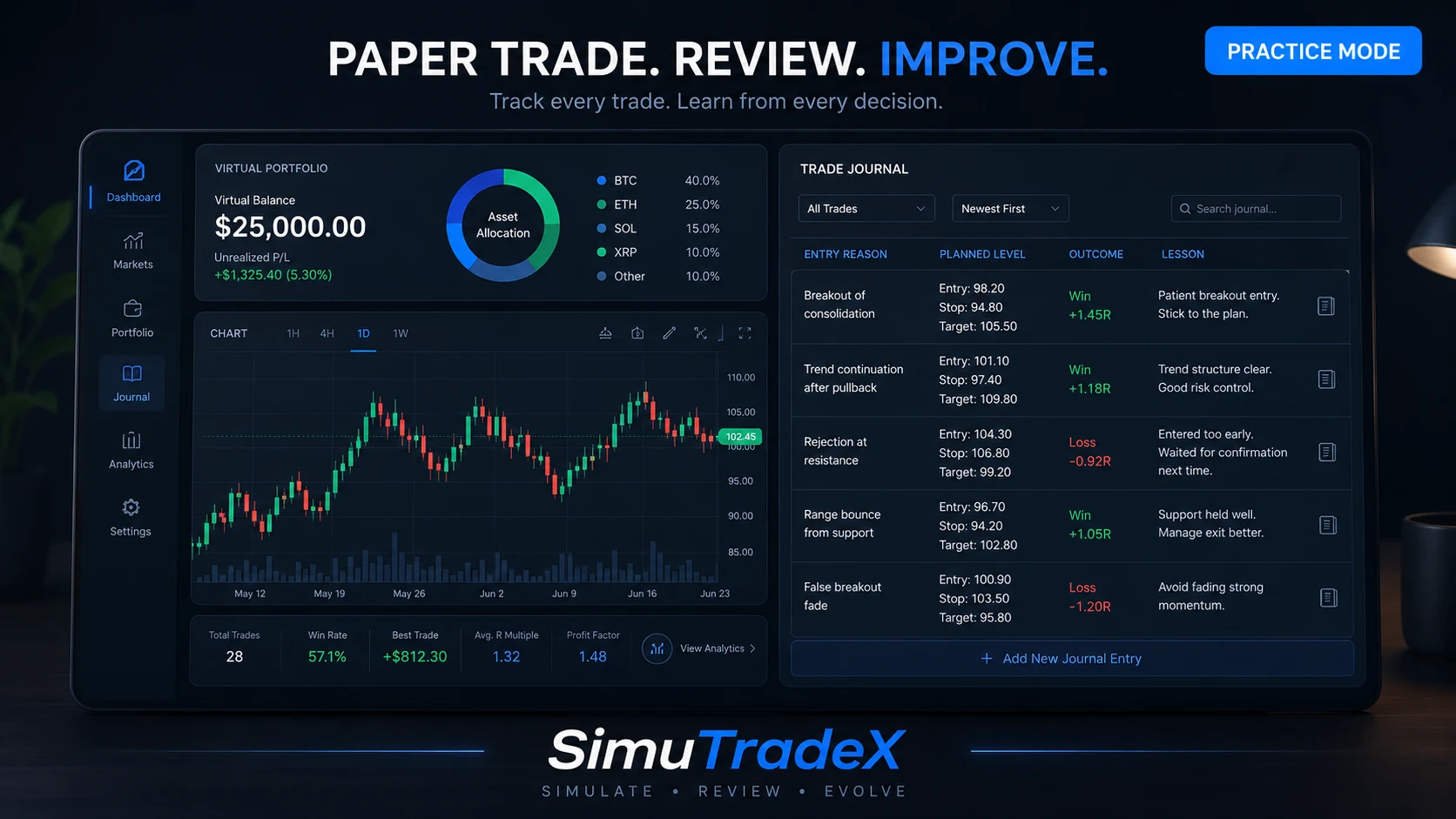
What Is a Crypto Paper Trading Journal?
A crypto paper trading journal is a record of simulated trading decisions made with virtual funds. It can include the asset, planned entry and exit levels, position size, reason for the trade, market context, alerts used, outcome, and lessons learned.
The purpose is not to create a perfect prediction log. It is to build evidence about your own process. Over several practice sessions, the journal can reveal whether you regularly act before your planned level, change a position without recording why, use inconsistent virtual position sizes, or repeat the same avoidable mistake.
A journal becomes more useful when it is connected to the rest of your practice workspace. Your virtual crypto portfolio shows allocation and exposure, while crypto price alerts can help you wait for planned levels. The journal explains the reasoning behind those choices.
Why Results Alone Are Not Enough
Beginners often evaluate a simulated trade with one question: “Did it work?” That question is understandable, but incomplete. Market movement contains uncertainty, so a favorable outcome does not automatically prove that the process was good.
Consider two paper trades:
| Practice trade | Process | Outcome | Review lesson |
|---|---|---|---|
| Trade A | Planned level, defined virtual size, clear invalidation, patient entry | Unfavorable | The process was consistent even though the outcome was not |
| Trade B | Impulsive entry, no written reason, oversized virtual allocation | Favorable | The result should not hide the weak process |
This distinction helps reduce outcome bias—the tendency to judge a past decision mainly by what happened afterward. In paper trading, the goal is to practice repeatable decision habits, not to celebrate every virtual gain or treat every virtual loss as proof of failure.
What to Record Before a Paper Trade
The best time to begin a journal entry is before the simulated order. Recording the plan first creates a reference that cannot be quietly rewritten after the market moves.
1. The practice idea
Write one or two sentences describing what you are testing. For example, you may be practicing patience around a planned level, comparing two virtual position sizes, or testing how an alert fits into your routine. Keep the idea observable and specific.
2. Market context
Note the timeframe you reviewed and the basic context you observed. Avoid turning the entry into a confident prediction. The journal should preserve what you saw at the time, not claim certainty about what comes next.
3. Planned entry and invalidation
Record the level or condition that would trigger the simulated decision. Also record what would show that the original idea no longer applies. Planned conditions make later review more objective.
4. Virtual position size
State how much virtual capital the practice position uses and how it changes overall allocation. Reviewing a trade without portfolio context can hide concentration. The portfolio workspace helps you see the simulated position as part of a whole rather than as an isolated bet.
5. Expected behavior
Write what you intend to do if the market reaches the plan, moves away from it, or remains inactive. This is a behavioral plan, not a price prediction. It helps you compare intended behavior with actual behavior later.
A Six-Step Paper Trading Journal Workflow
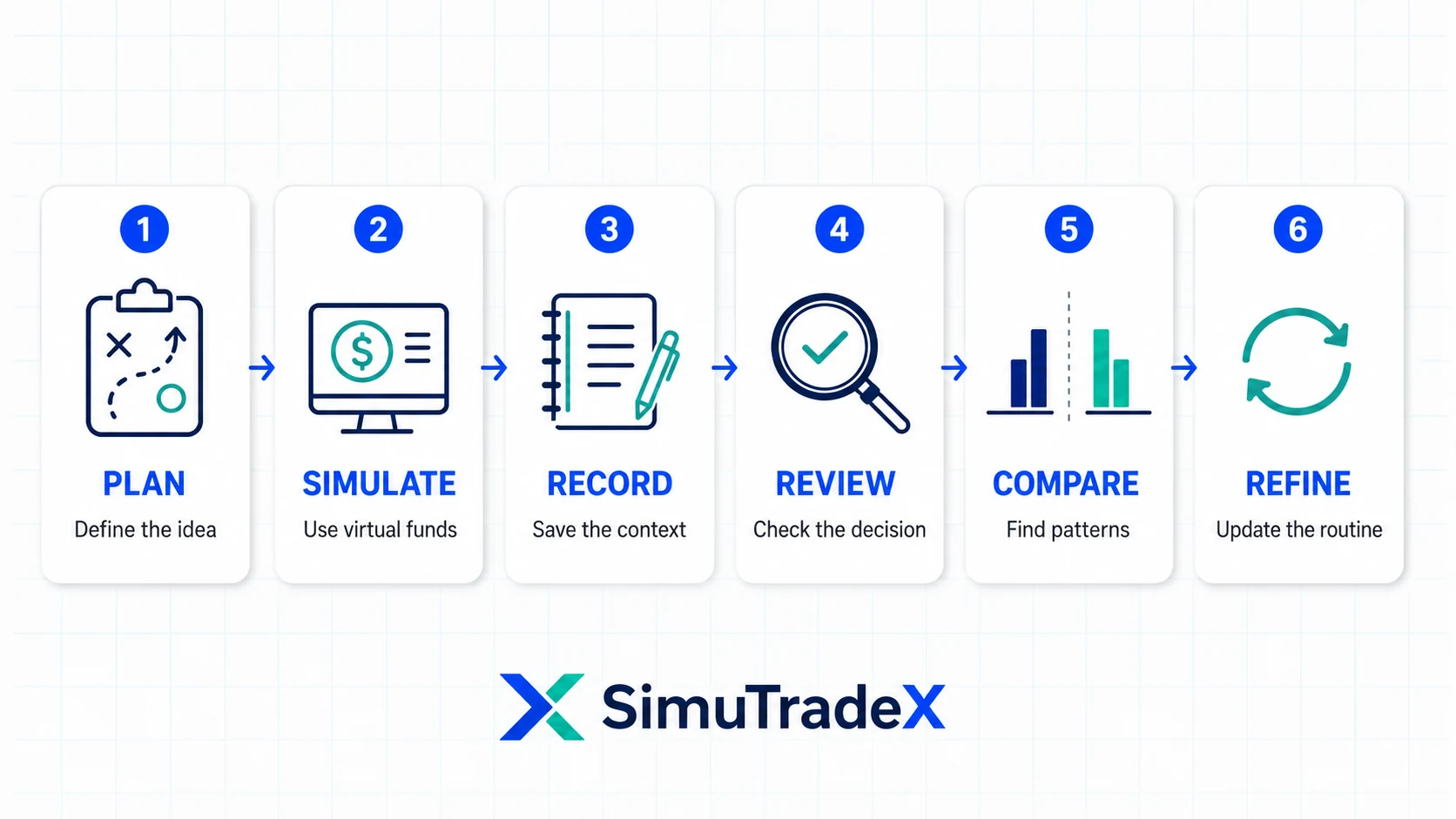
- Plan: Define the practice idea, conditions, virtual size, and intended response.
- Simulate: Make the decision with virtual funds rather than real money.
- Record: Save the context while it is still fresh, including any deviation from the plan.
- Review: Examine both the outcome and the quality of the decision.
- Compare: Look across several journal entries for recurring behaviors.
- Refine: Choose one small adjustment for the next practice cycle.
This loop is more valuable than writing long notes once and never revisiting them. A short, consistent journal entry creates comparable data. When each entry uses similar fields, patterns become easier to identify.
How to Review a Completed Paper Trade
Review after the position is closed or after the practice scenario has reached its planned endpoint. Start with the original entry rather than with the final chart. This helps you judge the information and assumptions that were actually available when the decision was made.
Compare the plan with the action
Did you wait for the recorded condition? Did you use the planned virtual size? Did you move the exit condition without documenting new information? A simple “planned versus actual” comparison is often more useful than a long market explanation.
Separate controllable and uncontrollable factors
You control preparation, sizing, alert settings, note quality, and whether you follow your routine. You do not control the next market move. A good review focuses most attention on the controllable part.
Write one lesson, not ten
Choose one practical lesson that can change the next session. Examples include waiting for an alert, reducing virtual concentration, recording an invalidation condition, or pausing before changing the plan. Too many simultaneous changes make it difficult to learn which adjustment helped.
Add portfolio context
Ask whether the simulated trade duplicated exposure already present in the virtual portfolio. A decision may look reasonable alone but create excessive concentration when viewed alongside other virtual positions.
An AI-ready portfolio snapshot can package positions, portfolio context, alerts, and notes for a clearer review. It should support your analysis rather than replace your judgment.
A Practical Review Checklist
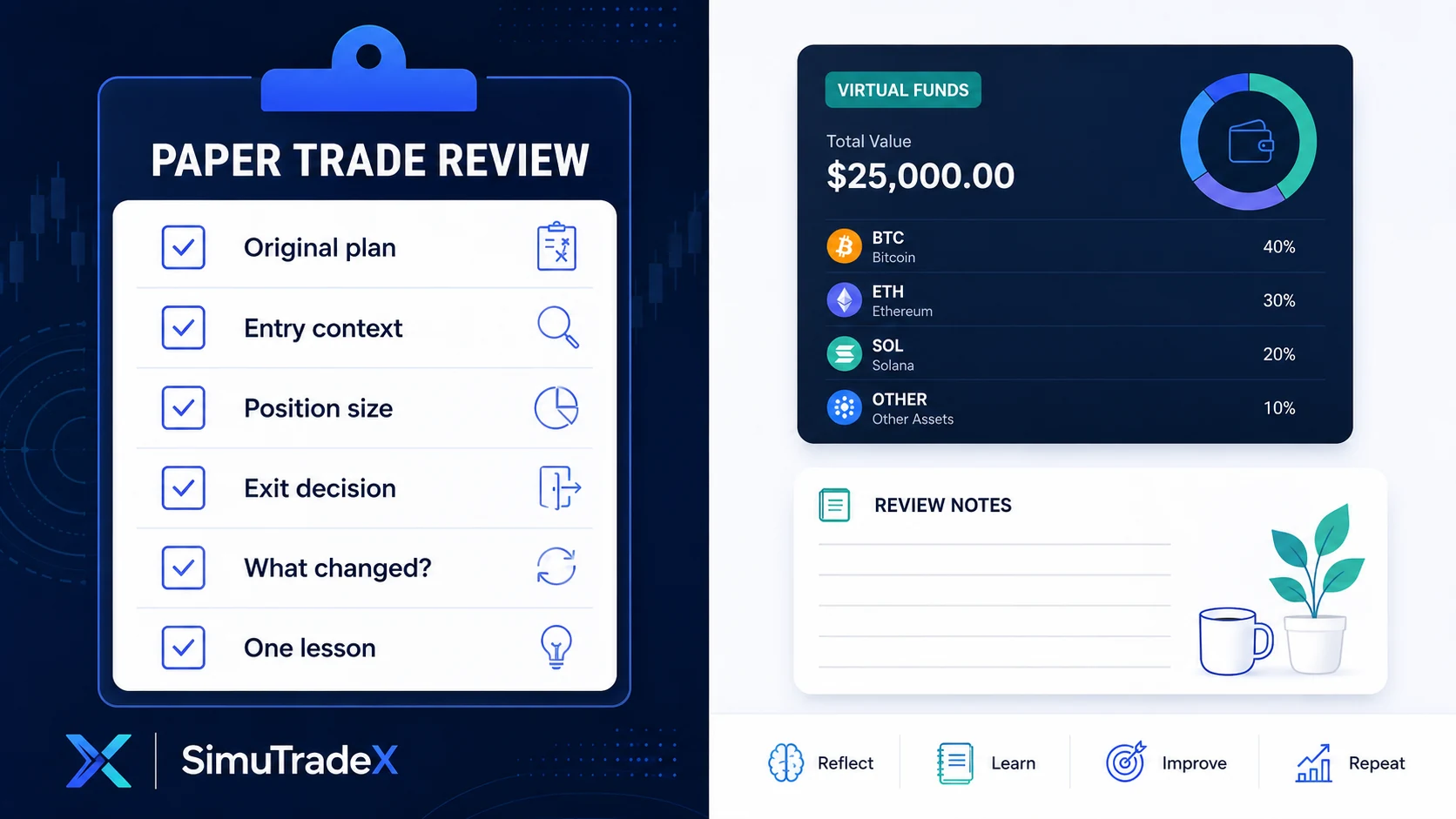
- Can I explain the original idea in one clear sentence?
- Did I record the context before making the simulated decision?
- Was the virtual position size consistent with my practice rules?
- Did I follow the planned entry and exit conditions?
- If I changed the plan, did I record what changed and why?
- How did this position affect virtual portfolio concentration?
- Did an alert help me act patiently, or did I ignore it?
- What is the single lesson I will test in the next session?
Weekly Review: Look for Patterns, Not Perfect Scores
A weekly review gives individual journal entries context. Choose a small group of completed paper trades and look for repeated behaviors. The goal is not to manufacture an impressive win rate. It is to understand whether your routine is becoming more consistent.
Useful review questions include:
- How often did I follow the condition written before the trade?
- Which deviations happened more than once?
- Did my virtual position sizes remain consistent?
- Were alerts used as planned?
- Did I record decisions immediately or reconstruct them later?
- Which lesson from last week actually changed my behavior?
You can also compare manual practice with simulated automation rules. A rule-based simulation may reveal whether your written conditions are precise enough to be tested consistently. It remains simulated practice; no real-money trade is executed.
Common Crypto Trading Journal Mistakes
Recording only winning or memorable trades
Selective records create a distorted picture. Log routine, unsuccessful, canceled, and inactive practice ideas as well. A decision not to act can also be worth reviewing when it follows a plan.
Writing the reason after the outcome
Memory naturally reshapes explanations. Record the core reason before the simulated trade, then add review notes separately. Keeping “before” and “after” fields distinct makes the journal more honest.
Using vague descriptions
Notes such as “looked good” or “bad market” are difficult to compare. Use observable language: the alert triggered, the planned level was reached, the virtual allocation exceeded the rule, or the entry happened before confirmation.
Tracking too many fields
An elaborate template can become a reason not to journal. Begin with a compact set of fields you can complete consistently. Add detail only when it improves a specific review question.
Changing the routine after every outcome
One result is a very small sample. Look for repeated behavior across several simulations before making major changes. When you do refine the routine, change one clear element and observe it in the next cycle.
Treating paper results as proof of real-world performance
Paper trading cannot fully reproduce liquidity, execution, fees, slippage, emotional pressure, or every technical condition of real trading. Journal results are educational evidence about a simulated process, not a promise of future performance.
How SimuTradeX Supports a Review Routine
SimuTradeX features are designed to keep paper trading practice connected. Virtual funds let you simulate decisions, the portfolio provides allocation context, alerts support planned levels, simulated automation helps test repeatable conditions, and the AI-ready snapshot organizes context for review.
A simple routine could be:
- Write the practice idea and planned conditions.
- Set a relevant price alert instead of watching every movement.
- Make the simulated decision with virtual funds.
- Record any change to the original plan.
- Review the position in portfolio context.
- Save one lesson for the next practice session.
You can start a paper trading workspace and use this journal structure alongside your virtual portfolio. Keep the focus on observation, discipline, and review rather than prediction.
Final Thoughts
A crypto paper trading journal is most useful when it is simple enough to maintain and structured enough to compare. Record the plan before the action, preserve the context, review the decision separately from the result, and refine one habit at a time.
The journal does not need to prove that every simulated trade was correct. Its real value is showing how decisions were made—and whether your process is becoming clearer, more patient, and more consistent.
Paper trading only. No financial advice. No real-money trades are executed.
FAQ
What is a crypto paper trading journal?
It is a structured record of simulated crypto decisions made with virtual funds. It usually includes the original idea, planned conditions, virtual position size, portfolio context, actual action, outcome, and review lesson.
What should beginners write in a paper trading journal?
Start with the asset, practice idea, entry condition, invalidation condition, virtual position size, reason for the decision, whether the plan was followed, and one lesson. Consistency is more important than a complicated template.
Should I journal a paper trade before or after it happens?
Do both in separate sections. Record the plan before the simulated decision, then add the actual action, outcome, and lesson afterward. This reduces the chance of rewriting the original reason based on what happened.
How often should I review paper trades?
Add a short review when each practice scenario ends, then compare several entries weekly. The weekly review is useful for identifying repeated behaviors that may not be obvious in a single trade.
Is paper trading the same as real trading?
No. Paper trading is a simulation and cannot fully reproduce execution, fees, slippage, liquidity, emotional pressure, or all real-market conditions. It is a tool for practicing a process with virtual funds.
Does SimuTradeX provide financial advice or execute trades?
No. SimuTradeX is for paper trading only. It does not provide financial advice, trading signals, price predictions, or real-money trade execution.