
Introduction
Crypto trading can look exciting from the outside. Prices move quickly, charts update every second, and beginners often feel pressure to make fast decisions. That pressure can easily lead to emotional trades, poor position sizing, overtrading, and weak review habits.
This is where crypto paper trading becomes useful.
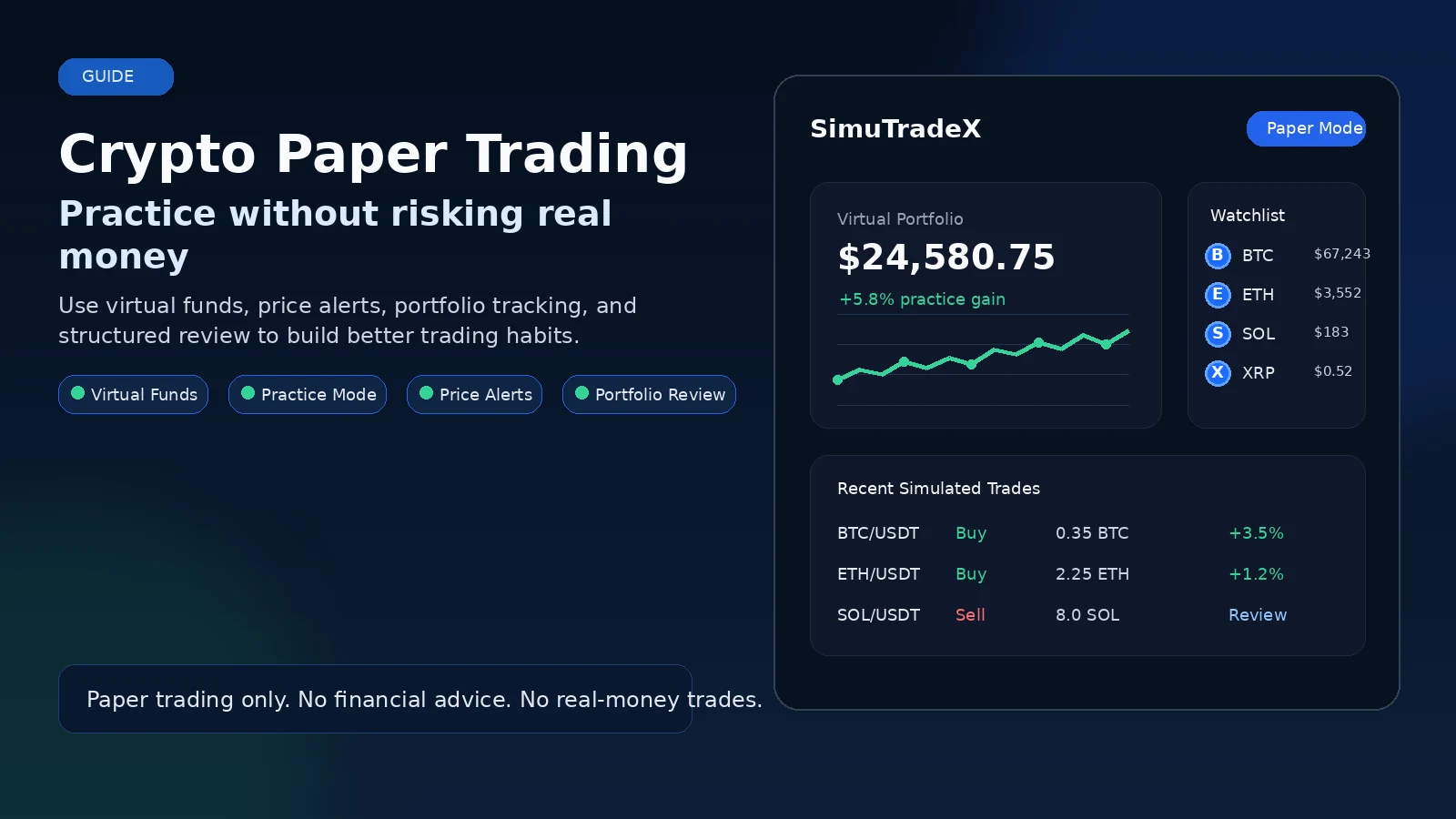
Crypto paper trading allows users to practice crypto buy and sell decisions with virtual funds instead of real money. It creates a safer learning environment where beginners and active learners can understand trading workflows, test ideas, track virtual performance, and build better discipline before real capital is involved.
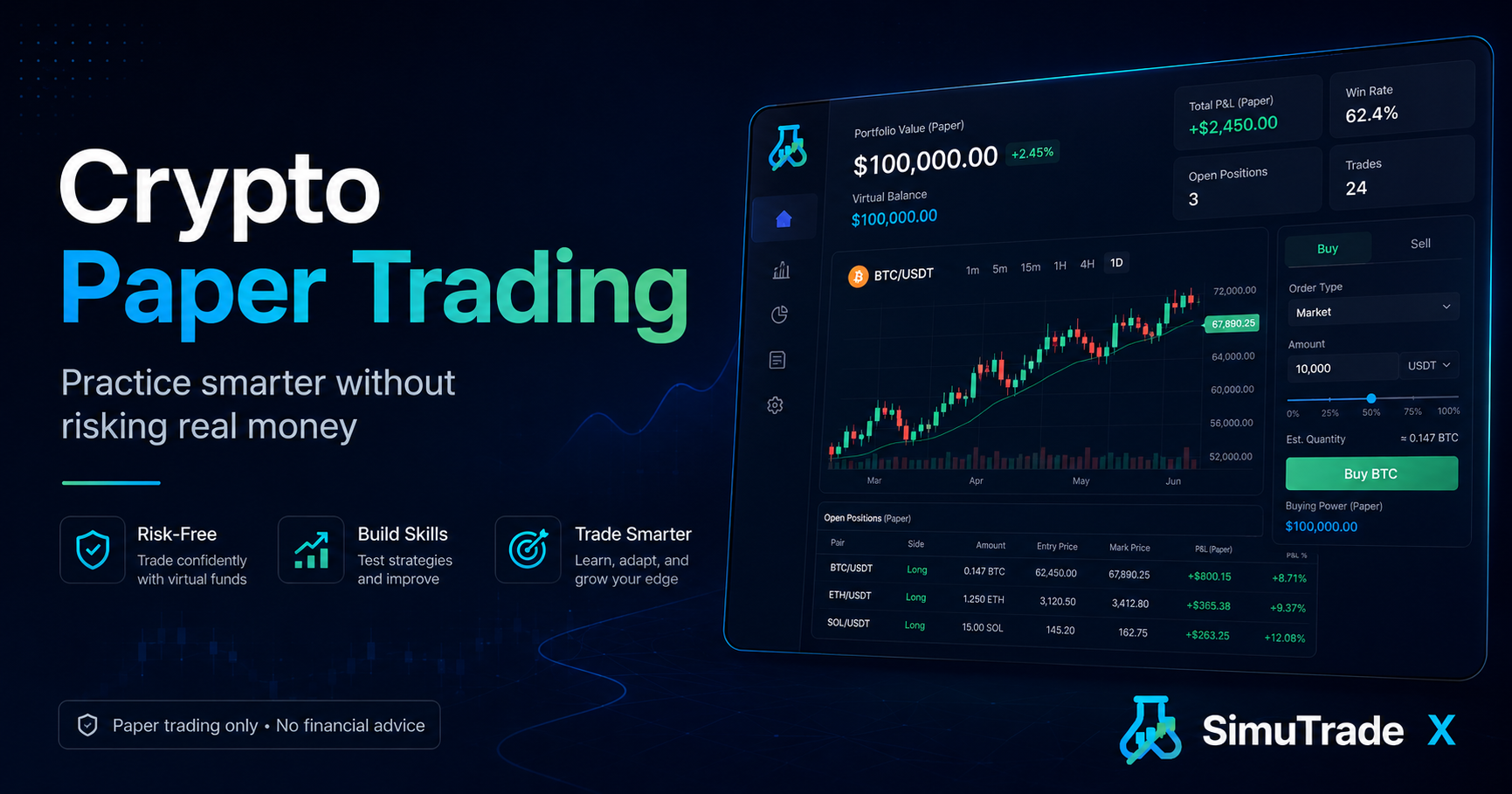
SimuTradeX is designed for this type of practice. It gives users a paper trading workspace where they can practice with virtual funds, build a virtual crypto portfolio, set crypto price alerts, test simulated auto trading rules, and use an AI-ready portfolio snapshot for structured review.
Important: SimuTradeX is for paper trading only. It does not provide financial advice, trading signals, price predictions, or real-money trade execution.
What Is Crypto Paper Trading?
Crypto paper trading is simulated crypto trading with virtual funds. Instead of placing real orders on a live exchange, users practice buy and sell decisions inside a simulated trading environment.
For example, a beginner may start with a virtual balance, choose a coin to monitor, open a simulated position, and then watch how that position changes as market prices move. The result is not a real profit or loss, but the process can teach useful lessons about timing, patience, risk awareness, and portfolio behavior.
In simple terms, crypto paper trading helps users:
- Practice with virtual funds
- Simulate crypto buy and sell decisions
- Track virtual positions
- Review portfolio changes
- Build a repeatable trading routine
- Learn without real financial loss
A crypto paper trading simulator is especially useful for beginners who want to understand the trading process before using real capital on other platforms.
Why Crypto Paper Trading Helps Beginners
Many beginners enter crypto trading without a clear process. They may buy because a coin is moving fast, sell because of fear, or change their plan too often. This usually creates random decisions instead of structured learning.
Paper trading helps slow that behavior down.
Instead of reacting to every market move, users can practice thinking before, during, and after each simulated trade. They can ask better questions such as:
- Why am I entering this trade?
- What price level am I watching?
- How much of my virtual portfolio is exposed?
- What would make me exit?
- Did I follow my original plan?
- What should I review after the trade?
This matters because trading is not only about choosing a coin. It is also about planning, execution, risk awareness, patience, and review.
SimuTradeX supports that process through its paper trading features, portfolio tools, alerts, simulated automation rules, and AI-ready review snapshots.
Crypto Paper Trading vs Real Trading
Paper trading and real trading are not the same. The biggest difference is emotional pressure.
When real money is involved, fear, greed, stress, and impatience usually become stronger. A trade that feels easy in a simulator may feel very different when actual capital is at risk.
Still, paper trading is valuable because it helps users build a routine before they face real-money pressure.
| Area | Paper Trading | Real Trading |
|---|---|---|
| Funds | Virtual funds | Real money |
| Financial Risk | No real financial loss | Real financial risk |
| Emotions | Lower pressure | Higher pressure |
| Main Purpose | Practice, learning, and review | Real execution and financial outcome |
| Best Use | Building discipline and testing routines | Executing real trades with real capital |
The best way to use paper trading is to treat it seriously. Random simulated trades usually teach very little. Planned paper trades, notes, alerts, portfolio tracking, and regular review create much better learning value.
How a Crypto Paper Trading Simulator Works
A crypto paper trading simulator usually combines market context, virtual balances, simulated orders, portfolio tracking, trade history, alerts, and review tools.
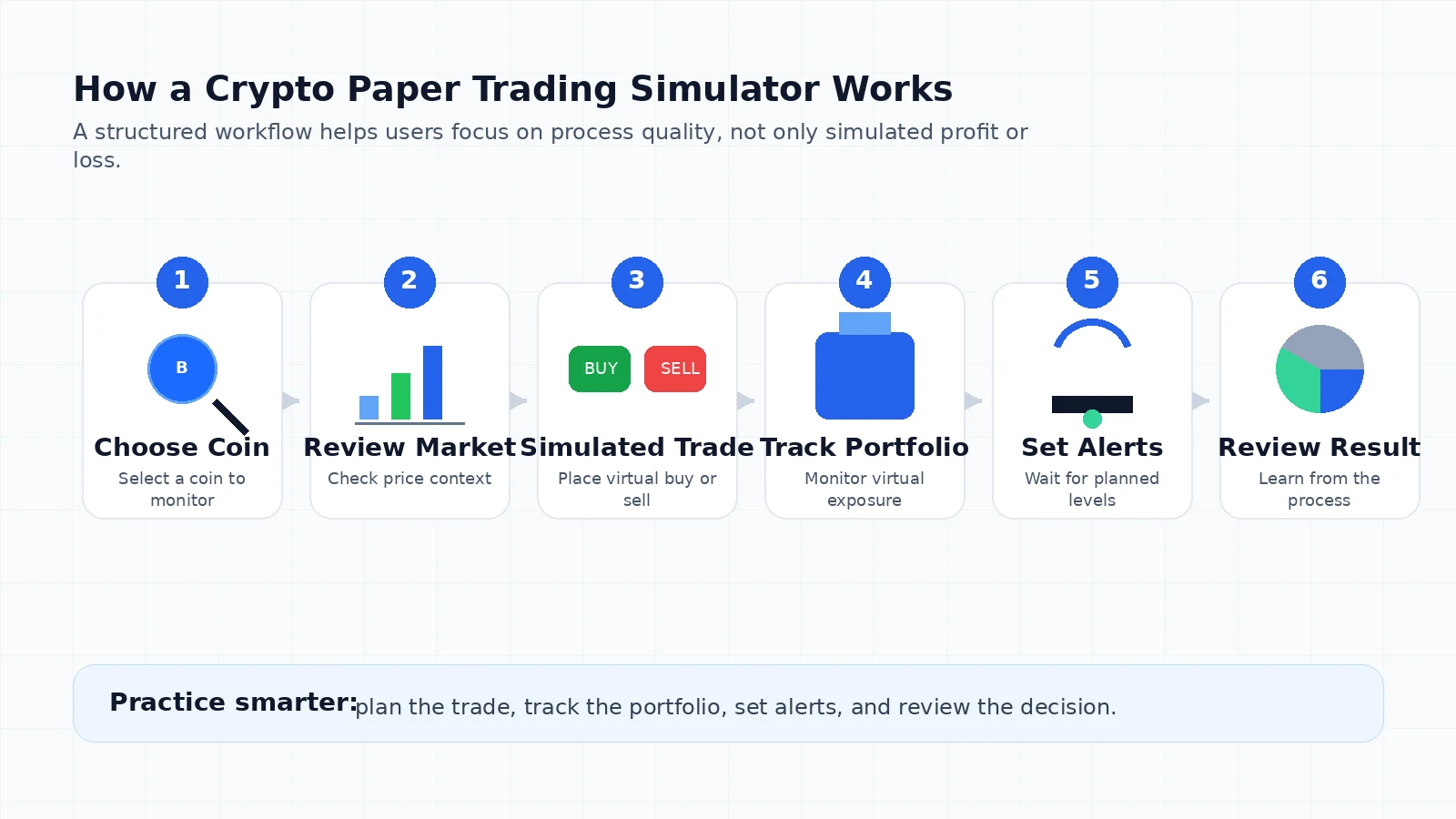
A simple practice workflow can look like this:
- Choose a coin to monitor.
- Review the market context.
- Define a reason for the simulated trade.
- Place a virtual buy or sell decision.
- Track the position inside a virtual portfolio.
- Set alerts for important price levels.
- Review trade history and portfolio performance.
- Export a structured snapshot for deeper review.
This workflow helps users move beyond random clicking. Instead of only asking whether the price went up or down, users can learn how to evaluate their decision-making process.
On SimuTradeX, users can move through this workflow by using the platform features, the virtual portfolio page, price alerts, simulated automation rules, and the AI Snapshot tool.
Building a Smarter Paper Trading Routine
A good paper trading routine should be simple, repeatable, and honest. The goal is not to create fake wins. The goal is to build better habits.
Start With a Clear Practice Goal
Do not open paper trades just to stay active. Choose one goal for each practice session.
For example, you can use a paper trading session to:
- Practice entries after pullbacks
- Test alerts around breakout levels
- Review position sizing
- Track how long trades stay open
- Compare different exit decisions
- Study how portfolio allocation changes
Having a clear goal makes the session easier to review later.
Use a Virtual Crypto Portfolio
A single trade does not show the full picture. A virtual crypto portfolio helps users understand how multiple positions affect account value, allocation, and risk exposure.
With portfolio tracking, users can review virtual cash, open positions, unrealized PnL, and overall portfolio exposure. This makes crypto paper trading more realistic and more useful.
For example, one simulated trade may look good on its own. But if the entire virtual portfolio is concentrated in one coin, that can reveal a weak risk habit.
Set Crypto Price Alerts
Price alerts can reduce emotional behavior. Instead of watching every candle, users can define important levels in advance and wait for those levels to be reached.
A crypto price alert is not a trading signal. It is a reminder that a planned level has been reached.
This helps users practice patience and encourages a more structured trading process because the decision is planned before the market reaches the level.
Review Every Paper Trade
Review is where most of the learning happens.
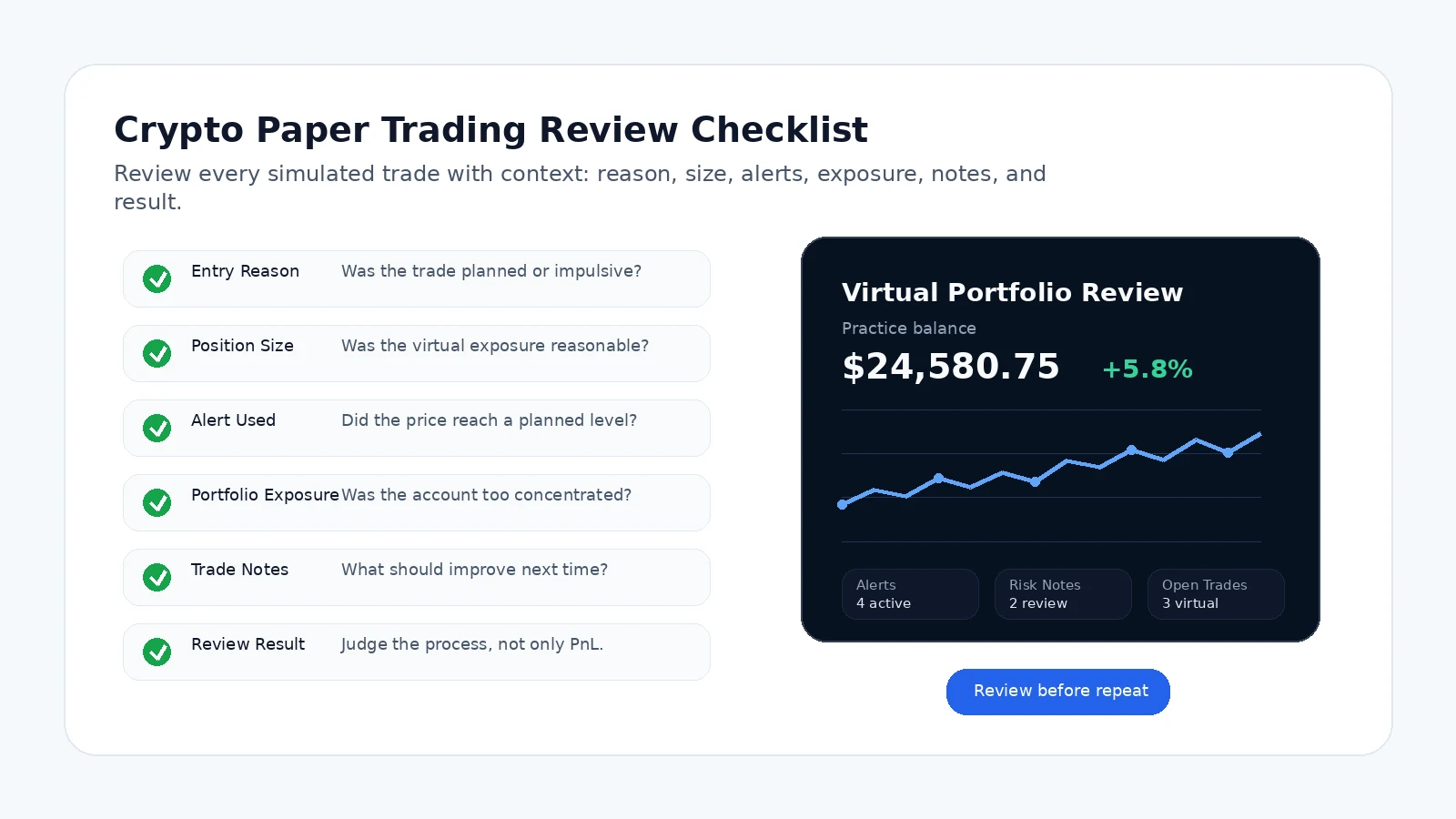
After closing a paper trade, users should ask:
- Why did I enter?
- Was the trade planned or impulsive?
- Did I follow the original idea?
- Did I wait for my alert?
- Was my position size reasonable?
- What would I change next time?
Without review, users may repeat the same mistakes. With review, paper trading becomes a practical learning system.
Use AI-Ready Portfolio Snapshots
A common problem in trading review is that users do not organize enough context. They may remember the result, but forget the reason behind the trade.
An AI-ready portfolio snapshot helps users copy structured portfolio context, including virtual balance, open positions, recent simulated trades, alerts, and risk notes.
This can make external AI review more useful because the discussion starts with clearer information.
Common Crypto Paper Trading Mistakes
Paper trading is helpful, but only when users take it seriously. Here are common mistakes to avoid.
Treating Virtual Money Like a Game
Because there is no real financial loss, some users take random trades. This can create bad habits.
The better approach is to treat virtual funds with discipline. The goal is not to chase fake profits. The goal is to practice better decisions.
Ignoring Position Size
Even in paper trading, position size matters. If a user puts most of the virtual portfolio into one coin, the simulator can teach an important lesson about concentration risk.
A strong practice routine should include portfolio review, not just individual trade results.
Focusing Only on Profit
A profitable paper trade can still be a poor decision if it was random. A losing paper trade can still be useful if it followed a clear plan.
Paper trading should be judged by process quality, not only by simulated profit.
Not Using Alerts
Many beginners react too quickly to price movement. Alerts help users define levels in advance.
Using price alerts can make practice sessions calmer and more intentional.
Skipping Trade Review
Without review, users lose the most valuable part of paper trading.
Trade history, portfolio tracking, alerts, and snapshots all support better review habits. That is why SimuTradeX focuses on the full practice workflow instead of only simulated buy and sell buttons.
Believing Paper Trading Guarantees Real Results
Paper trading does not guarantee success in real trading. Real money creates stronger emotions, and live market execution includes real financial risk.
Paper trading is a learning tool. It is not a profit system, prediction engine, signal service, or guaranteed path to real trading results.
How SimuTradeX Supports Crypto Paper Trading
SimuTradeX is designed as a crypto paper trading workspace, not an exchange and not a signal service.
The platform focuses on practice and review through tools such as:
- Crypto paper trading with virtual funds
- Virtual portfolio tracking
- Market overview and watchlist
- Crypto price alerts
- Simulated auto trading rules
- Trade history review
- AI-ready portfolio snapshots
- Risk awareness reminders
This structure helps users practice more intentionally.
Instead of only asking “Did the price go up?”, users can ask better questions:
- Did I follow my plan?
- Was my position size reasonable?
- Did I wait for my alert?
- What happened to my virtual portfolio?
- What can I improve in my next paper trade?
That is the real value of crypto paper trading: building a better process before real capital is involved elsewhere.
When Should You Move From Paper Trading to Real Trading?
There is no universal timeline. Some users may practice for weeks, while others may need months.
Before considering real-money trading elsewhere, users should be able to:
- Explain their trading plan clearly
- Track performance honestly
- Avoid random overtrading
- Understand position size and risk
- Review losing trades without panic
- Follow planned entry and exit rules
- Accept that real trading involves financial risk
Even then, real trading should be approached carefully. Paper trading can help users prepare, but it cannot remove real market risk.
Final Thoughts
Crypto paper trading is one of the most practical ways to learn trading workflows without risking real money.
It gives beginners and active learners a place to practice decisions, track virtual portfolios, set alerts, test simulated rules, and review performance.
The key is to treat paper trading seriously.
Use a plan. Track results. Review mistakes. Build discipline. Then repeat.
SimuTradeX helps users do exactly that in a focused crypto paper trading workspace.
Start with the SimuTradeX features, build a virtual portfolio, set price alerts, test simulated rules, and use an AI-ready snapshot to review your progress.
Paper trading only. No financial advice. No real-money trades are executed.
FAQ
What is crypto paper trading?
Crypto paper trading is simulated crypto trading with virtual funds. It helps users practice buy and sell decisions, track virtual portfolios, and review outcomes without risking real money.
Is crypto paper trading good for beginners?
Yes. Crypto paper trading can help beginners understand trading workflows, portfolio tracking, alerts, trade review, and trading discipline before using real capital elsewhere.
Is paper trading the same as real trading?
No. Paper trading does not involve real financial risk, so the emotional pressure is lower. It is useful for practice, but it does not guarantee real trading results.
Can I paper trade crypto without real money?
Yes. A crypto paper trading simulator lets users practice with virtual funds instead of real money.
Does SimuTradeX provide financial advice?
No. SimuTradeX is for educational and simulated paper trading purposes only. It does not provide financial advice, trading signals, price predictions, or guaranteed outcomes.
Does SimuTradeX execute real crypto trades?
No. SimuTradeX does not execute real-money trades. It is a paper trading and practice workspace.